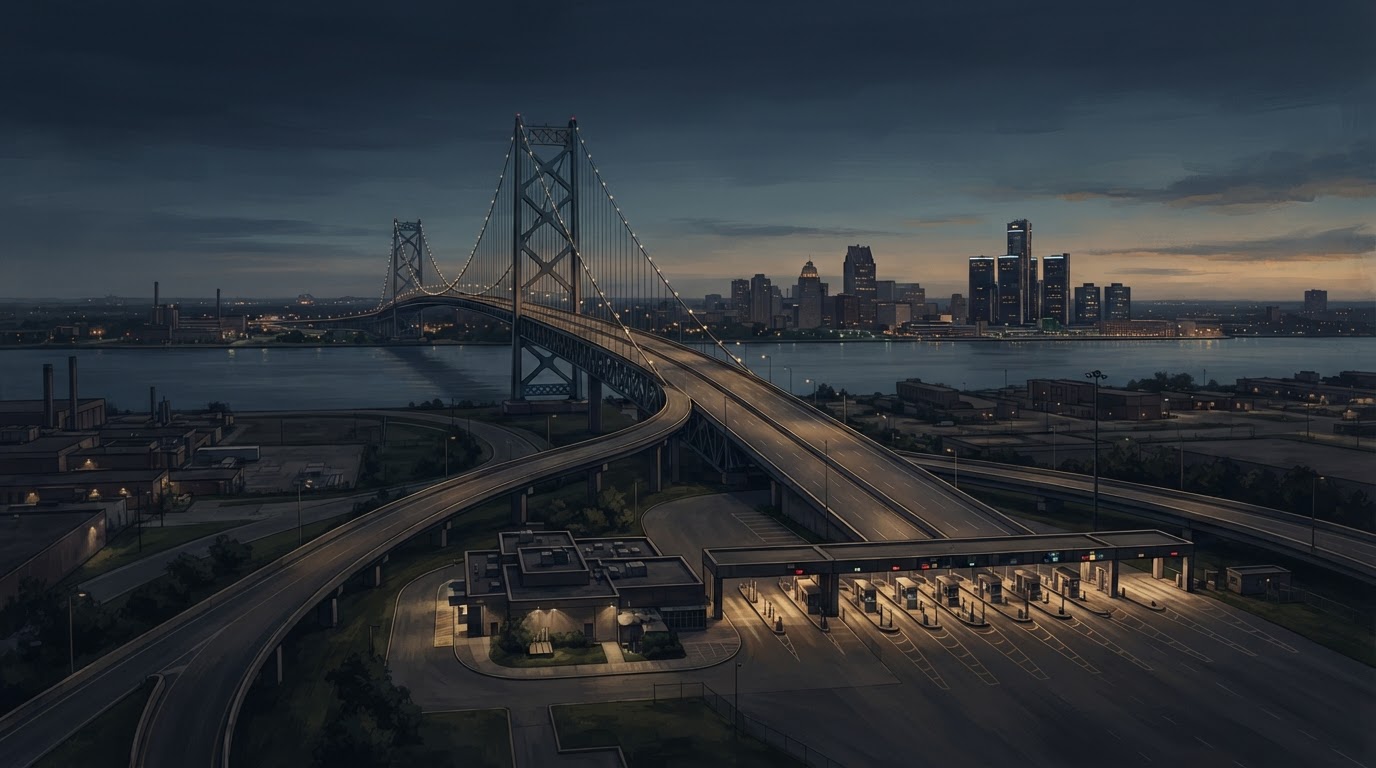
The Gordie Howe International Bridge linking Windsor, Ontario, and Detroit, Michigan, is physically finished, but its opening keeps sliding, and the reasons keep changing. Prime Minister Mark Carney told reporters this week that the opening date could move again, though he insisted there is ‘no big drama’ about the delay, according to apnews.com. That was not the first time Carney has had to explain a moving target on this file. In June, an expected opening was postponed after what Carney described as a request from the United States, and a new date of July 27 was later set only after weeks of closed-door negotiation, as reported by cp24.com.
The underlying dispute is money, not concrete. Canada spent roughly $6.4 billion building the crossing and originally expected to collect all toll revenue until that debt was repaid, a process once projected to take about 50 years. Under the agreement in principle now governing the bridge, Canada will share 50 per cent of net revenues, after operating costs, with the United States for the first 15 years, according to details published by cp24.com. Carney has repeatedly stressed that this is not the same as splitting tolls outright, telling reporters in London, Ontario, that ‘any sharing of the toll revenue won’t happen until all of the debt is repaid,’ while conceding separately that net revenues in early years are expected to be ‘negative to modest,’ as reported by cp24.com.
A prime minister explaining his own explanation
The confusion has not been limited to the public. Carney himself admitted in Charlottetown in July that he ‘should have been clearer’ when asked directly whether he had misled Canadians about the terms of the deal, according to ottawacitizen.com. The published agreement, released by the Windsor-Detroit Bridge Authority, did not contain the debt-recovery language Carney had earlier described to CTV Calgary, a discrepancy that surfaced only after days of political pressure, per the same report. Carney maintained afterward that ‘the underlying agreement between Canada and Michigan remains in place’ and that there is ‘no splitting of tolls’ under that agreement, even as critics noted the net-revenue formula effectively shares proceeds with Washington far sooner than Canadians had been led to expect.
Against that backdrop, Windsor’s mayor has publicly urged Ottawa not to concede further ground. Local reporting has framed the mayor’s remarks as a direct warning that federal negotiators should not accept a deal that shortchanges the city that has waited years for the bridge to open, hosted the construction disruption, and expects the economic benefits promised since the project was first announced. For residents and businesses in Windsor, the practical question is straightforward: after a decade of construction and repeated delays tied to cross-border politics, when does the bridge actually open for ordinary trade and travel, and on what terms.
How the outlets framed it
Coverage of the same week’s events pulled in different directions even from reporting built around Carney’s own words. One thread of reporting, echoed in outlets like the Associated Press, presented Carney’s ‘no big drama’ comment as a calming signal that any delay is minor and the bridge’s long-term benefits are secure. A separate thread of reporting on Windsor’s mayor treated the same delay as evidence that Ottawa might be prepared to cave to American pressure on toll-sharing terms, framing the pause as a warning sign rather than a footnote. Read together, the two framings reveal a genuine tension: federal messaging aims to project confidence and control, while local officials and residents in Windsor are reading the same facts as proof that the terms of the deal are still being negotiated at their expense.
What is not in dispute is the money and the timeline. Canada financed the bridge, expected decades of exclusive toll revenue to recover that cost, and has now agreed, at least in principle, to share net revenues with the United States far earlier than originally planned. Whether that arrangement represents a fair trade for finally getting trucks and travellers across the river, or a concession extracted under pressure from Washington, remains the real story behind the announcement that the opening could ‘take a little longer.’