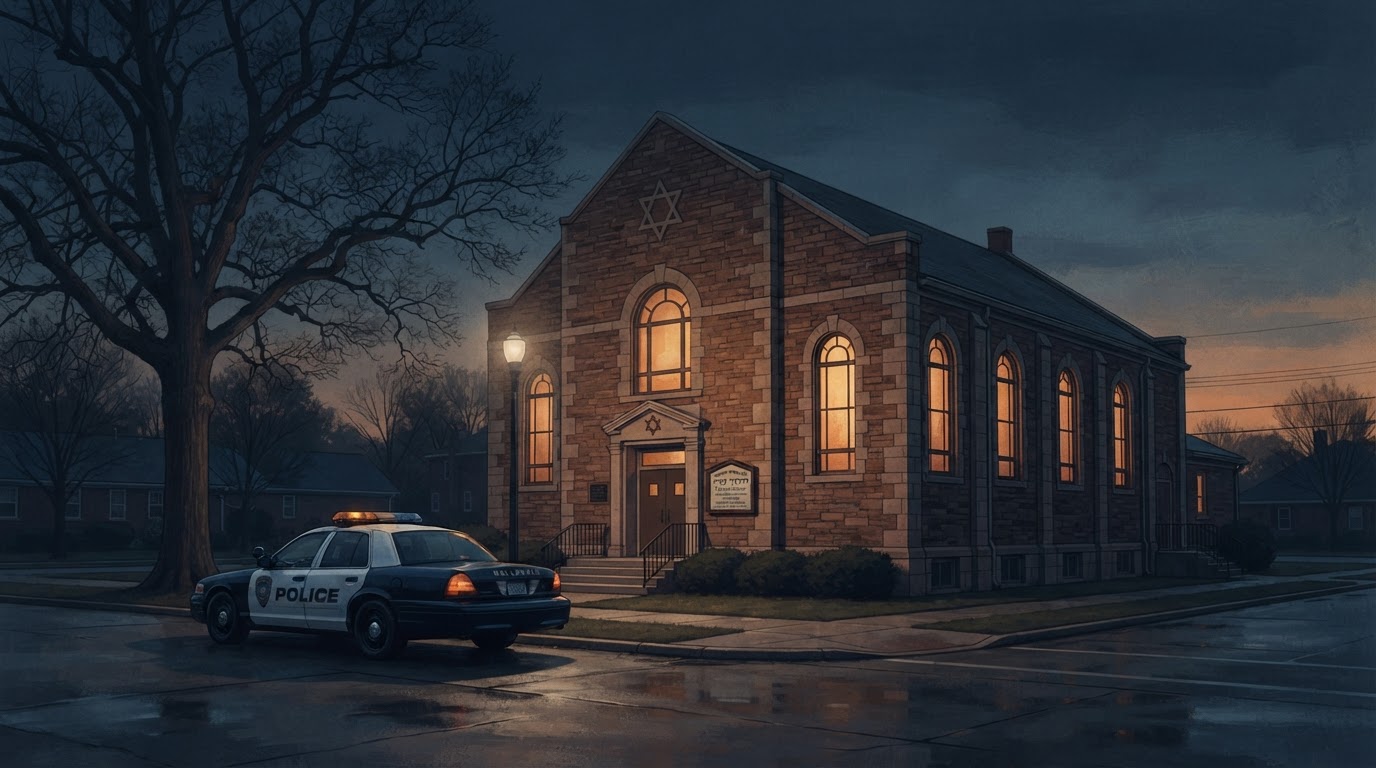
Belleville Police Chief Murray Rodd told reporters on September 24 that the shooting outside the Sons of Jacob synagogue on Yom Kippur was a premeditated, targeted hate crime aimed specifically at the Jewish community, according to CityNews Toronto. Rodd said investigators had gathered confirmation and corroboration supporting that conclusion before the case moved forward under Ontario’s hate-crime standards.
The attack happened on the evening of September 20, the start of Yom Kippur, the holiest day on the Jewish calendar, as roughly two dozen congregants gathered inside for services, according to the BBC. A man armed with a shotgun opened fire on a police officer stationed outside the building as part of a long-standing security arrangement with the congregation. That officer, Constable Jeff Smith, was shot multiple times and remains in hospital, according to CBC News. A second officer arrived shortly afterward and exchanged gunfire with the attacker, who died from his injuries.
B’nai Brith Canada said in a statement carried by CityNews that the shooting must be a wake-up call for Canada, adding that the organization had warned for months that rising antisemitic incidents made serious injury or death only a matter of time. The group also called for stronger enforcement against hate speech and for legal changes allowing armed private security at synagogues and other vulnerable institutions.
Survivor speaks of fear and community resolve
Sharlene Weitzman, who was inside the synagogue with her partner and son during the attack, later described the experience publicly and thanked the two officers for saving her family’s lives, according to the Globe and Mail. Noah Shack, head of the Centre for Israel and Jewish Affairs, told a press conference on Parliament Hill that the attack could have happened anywhere in Canada and pointed to a broader pattern of hate-motivated incidents affecting schools, seniors’ homes, workplaces and universities, according to 980 CJME. Simon Wolle, chief executive of B’nai Brith Canada, visited Belleville the same week and repeated the call for armed private security and dedicated police funding at Jewish institutions nationwide, per the same CJME report.
Chief Rodd also said police had no intelligence or warning that would have flagged the attack in advance, according to CityNews. That statement leaves open the question of how threat assessment works across police services generally, since the case has drawn attention to a wider pattern of antisemitic threats and violence flagged repeatedly by Jewish organizations over recent months, without pointing to any single missed signal in this particular case.
How the outlets framed it
CityNews and the BBC centred their coverage on the police chief’s official classification of the shooting as a hate crime and on the survival of the two responding officers, presenting the event largely through the lens of law enforcement’s account. The Globe and Mail and 980 CJME shifted the frame toward the Jewish community’s own voice, foregrounding a survivor’s personal statement and a national advocacy group’s demand for structural changes to security policy. The difference shows two separate stories running in parallel: one about what police confirmed happened, and another about what Jewish Canadians say the attack reveals about their safety more broadly, a distinction the initial police-briefing coverage did not fully capture.
Together, the reporting establishes a shooting that police have formally classified as targeted and premeditated, a survivor’s account of fear and gratitude toward the responding officers, and a Jewish advocacy sector pressing governments for concrete security changes rather than statements of condemnation alone.