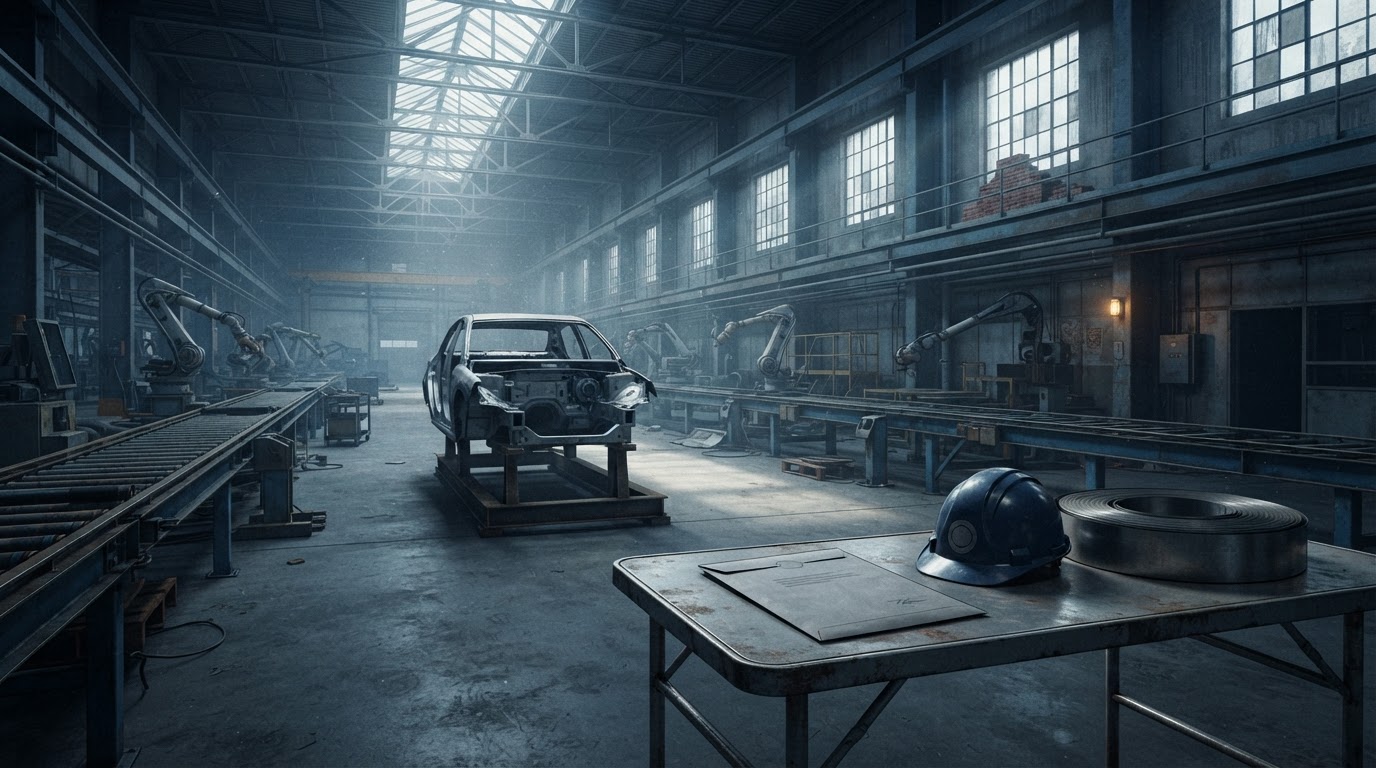
Stellantis confirmed on Friday 11 September that it had signed a memorandum of understanding with the Canadian armoured vehicle maker Roshel covering a potential sale of its idled assembly plant in Brampton, Ontario. Five days later, Ontario Premier Doug Ford and federal Industry Minister Mélanie Joly both told reporters in Toronto that they want the automaker to commit a new vehicle model to the site instead. “We want a new model from Stellantis at the Stellantis plant and we’ll put maximum pressure to make that happen, and if they don’t, we’ll get our money back,” Joly said, according to The1News.
The plant has produced nothing since 2023. It was taken offline to be retooled for the Jeep Compass, the retooling was paused in early 2025, and Stellantis later moved Compass production to the United States. The1News reported that the federal government threatened legal action over that decision, on the basis that Stellantis had signed an agreement with Ottawa and Ontario whose commitments included a production mandate at Brampton in return for a $15-billion performance incentive.
What the public record actually shows
That $15-billion figure is the centre of the story, and it is also the part the public can least easily check. It refers to performance-based incentives tied to production volumes and investment milestones, structured so that money flows as conditions are met. Ford was blunt about what has been paid out so far on this particular building. “The province has not given Stellantis a penny for the Brampton facility, but in saying that, we want to work with them,” he said, as reported by Global News.
Both statements can be true at once, and together they expose the weakness in the ministerial promise. If little or no money has been disbursed against the Brampton mandate, then “getting our money back” recovers very little, and the governments’ leverage rests on a contract whose text, milestones and penalty clauses have never been tabled publicly. Neither government has released the agreement. Taxpayers are being asked to accept that a deal exists, that it was strong enough to bind a multinational, and that it will now be enforced, without seeing the clause that would do the enforcing.
Unifor national president Lana Payne wrote to Joly on Wednesday 16 September arguing that a sale would mean Stellantis had “abandoned” vehicle production at Brampton, leaving more than 2,000 employees out of work and hitting nearby suppliers. Payne wrote that the proposal to sell to a company that is not an automaker “never should have been considered in the first place,” and she called it a disaster scenario for the Canadian auto industry, according to Global News. Her letter also stated that bargaining is at an impasse, with the collective agreement expiring at 11:59 p.m. on 20 September.
The buyer tells a different story about the same building. Global News reported that Roshel chief executive Roman Shimonov said the company intends to establish a Canadian Centre of Excellence for Defence Manufacturing in Brampton alongside automotive production, that it is prepared to offer letters of commitment giving first consideration to laid-off Unifor workers, and that it expects to bring back more than 2,000 jobs through the federal Light Utility Vehicles procurement programme and other work. Stellantis Canada chairman, president and chief executive Trevor Longley said last week that the company had reviewed multiple options and regarded Roshel as a strong path to restoring sustainable operations at the site.
Why the trade war changes the arithmetic
The timing deserves attention. On 16 September, President Donald Trump signed a presidential memorandum directing United States federal agencies to strip Canadian-origin products out of government procurement, an escalation the White House justified by pointing to Canada’s “Buy Canadian” policy, as reported by the National Post. Bloomberg reporting carried by The Straits Times noted Trump’s earlier claim that Canadian goods and services sold under the Multiple Award Schedule are worth more than US$50 billion a year, with a senior administration official clarifying that Canadian firms do not account for all of that figure.
A government that is being shut out of American procurement has less to offer a Detroit-headquartered automaker and more reason to want domestic defence capacity on Canadian soil. That is the awkward question behind the Brampton file. If the only bidder willing to restart the building is a defence manufacturer selling into Canadian procurement programmes, then Ottawa’s public position and its industrial interest are pointing in opposite directions.
How the outlets framed it
The1News and Global News both built their coverage around the statements of Ford, Joly and Payne, treating a returning Stellantis assembly mandate as the obvious good outcome and the Roshel memorandum as the thing to be resisted. Global News did carry Roshel’s job commitments and Stellantis Canada’s reasoning, which The1News largely left out. Neither outlet placed the file beside the same week’s trade reporting from Bloomberg and the National Post, which described Washington closing procurement and import channels to Canadian suppliers. Read together, those two story lines suggest Ottawa’s bargaining power over a United States-headquartered automaker is shrinking at exactly the moment ministers are promising maximum pressure, and that a defence buyer may be the only buyer available.
The verifiable test is straightforward. Ottawa and Ontario can publish the agreement, the milestone schedule and the repayment terms. Until they do, the promise to recover public money is a claim about a document nobody outside government has read.