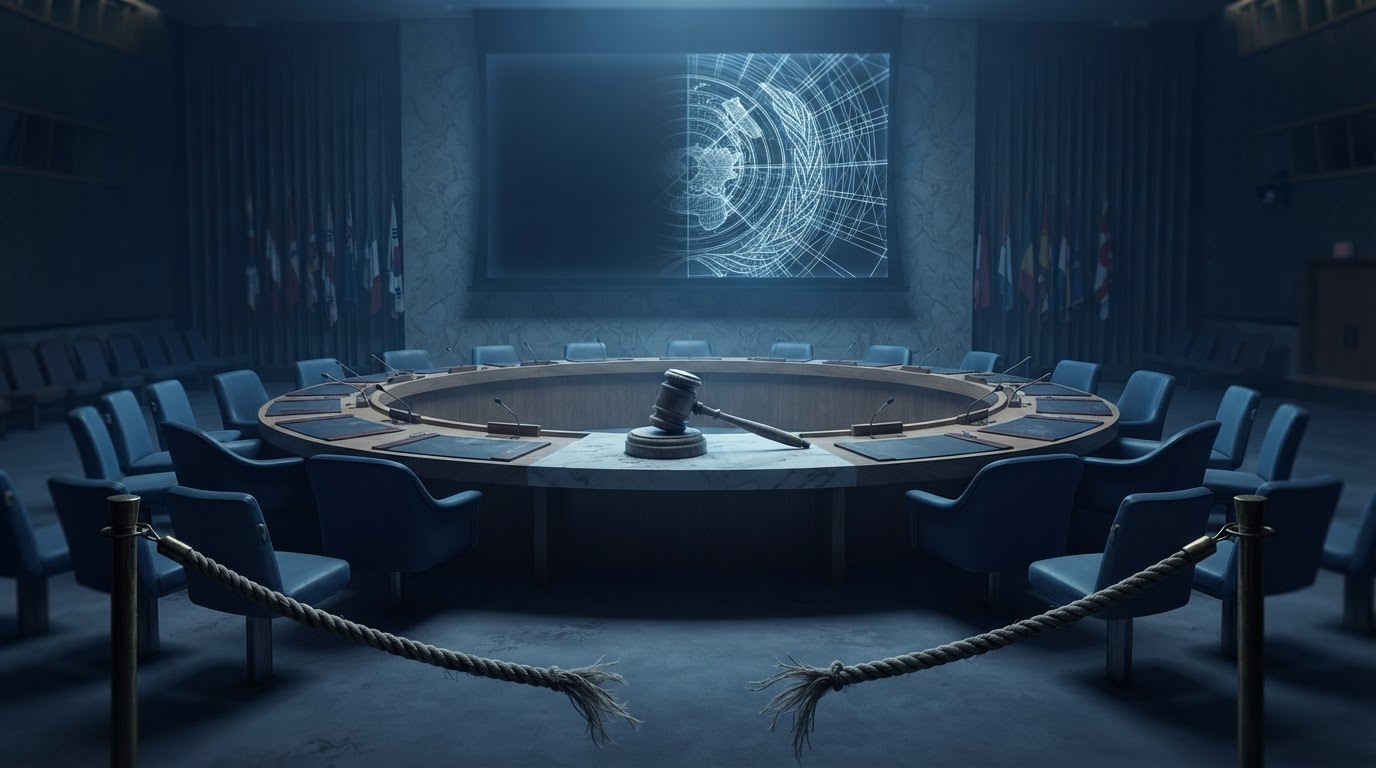
Six days before world leaders arrived in New York for the high-level week of the 81st session of the General Assembly, the Secretary-General of the United Nations gave an unusually blunt account of the state of his own organisation. Asked why repeated appeals to respect international law have gone unheeded, António Guterres told reporters on 16 September 2026 that the problem is structural. “We have geopolitical divides, and in these geopolitical divides, we have powers that themselves violate international law and sit in the Security Council,” he said, according to thehindu.com, adding that this has been paralysing the Council. aljazeera.com reported the same exchange and the same attribution of blame to the conduct of major powers.
He went further than a complaint about gridlock. The Secretary-General said that because the example set by the biggest powers is a poor one, every country now feels entitled to do as it wishes, knowing it will act with impunity because the body charged with maintaining peace and security cannot function, as recorded by thehindu.com. That is a description of a collapsed enforcement system delivered by the official who leads it.
His proposed remedy was a redistribution of power. He said power relations no longer correspond to the realities of the world, and that reform is essential in two multilateral institutions above all, the Security Council and the Bretton Woods system created by the 1944 monetary agreement, according to aljazeera.com and thehindu.com. Neither reform can proceed without the agreement of the same permanent members he had just described as violators of international law, which is the circularity at the centre of the proposal.
The same press conference asked for new global authority over artificial intelligence
The Secretary-General devoted close to half of his remarks to artificial intelligence. He said the world had entered an era of deep uncertainty and identified three existential threats, namely runaway artificial intelligence, the climate crisis and deepening inequalities, according to news.un.org. He acknowledged the technology’s enormous potential in health, education and climate work, then warned that development is racing ahead of human understanding of the risks. He said national action is essential while global cooperation is indispensable, that voluntary pauses will fail if they are limited to a few countries, and that the world cannot afford a race to the bottom on AI safety. He pointed to the UN-founded Independent International Scientific Panel on AI as the body that will supply evidence to global discussions, and called for guardrails that make the technology safe, transparent and accountable.
The organisation’s own news service put the question directly in a companion piece headlined around who should set the rules for AI, and answered it by describing a United Nations push for a safer digital future (news.un.org). The sequence deserves scrutiny. Within a single hour, the institution conceded that its flagship organ cannot restrain its own permanent members, and then asked member states to route the governance of the most consequential technology of the decade through multilateral machinery of the same kind. If the veto and great-power divergence have neutralised the Council on war and occupation, the burden of proof sits with the United Nations to explain why they would not neutralise a global AI framework in the same way.
Political resistance was already visible. channelnewsasia.com reported that the warning put Guterres at odds with President Donald Trump, who has argued that existing safeguards are sufficient. independent.co.uk reported that Trump this week called claims that AI might destroy humanity “a HOAX” and described efforts to limit the technology as part of a “SICK conspiracy”. The same report said Guterres was responding to a proposal from Anthropic chief executive Dario Amodei for a coordinated slowdown among leading companies and governments, that Sam Altman and Elon Musk have recently said development needs to slow, and that Mark Zuckerberg distanced Meta by saying each company must ensure its own technology is safe.
How the outlets framed it
The three accounts of one press conference diverge sharply. UN News presents the artificial intelligence agenda as constructive multilateralism, with governments urged to embrace cooperation, a new scientific panel supplying evidence, and guardrails placing human dignity at the centre. Channel NewsAsia and the Reuters copy it carries reduce the event to a personality contest, with the Secretary-General sounding an alarm while the American president plays the danger down. The Hindu and Al Jazeera preserve what the other two soften, which is the admission that permanent members break international law, that the Council is therefore paralysed, and that impunity has spread outward from that paralysis. The difference matters because only the third framing leaves readers able to judge whether the institution asking for expanded authority over AI has demonstrated competence with the authority it already holds.
Questions the high-level week is unlikely to answer
The United Nations describes itself as the guarantor of international peace and security, and its charter assigns that role to the Security Council. Its own Secretary-General has now said in public that the organ does not work, and that the reason is the conduct of the states holding permanent seats. A reform of the Bretton Woods institutions faces the same arithmetic of shareholdings and vetoes. Governments arriving in New York are being asked to accept a diagnosis of institutional failure and a prescription of institutional expansion at the same time, and the record described from the podium on 16 September gives them ample reason to ask how the second follows from the first.