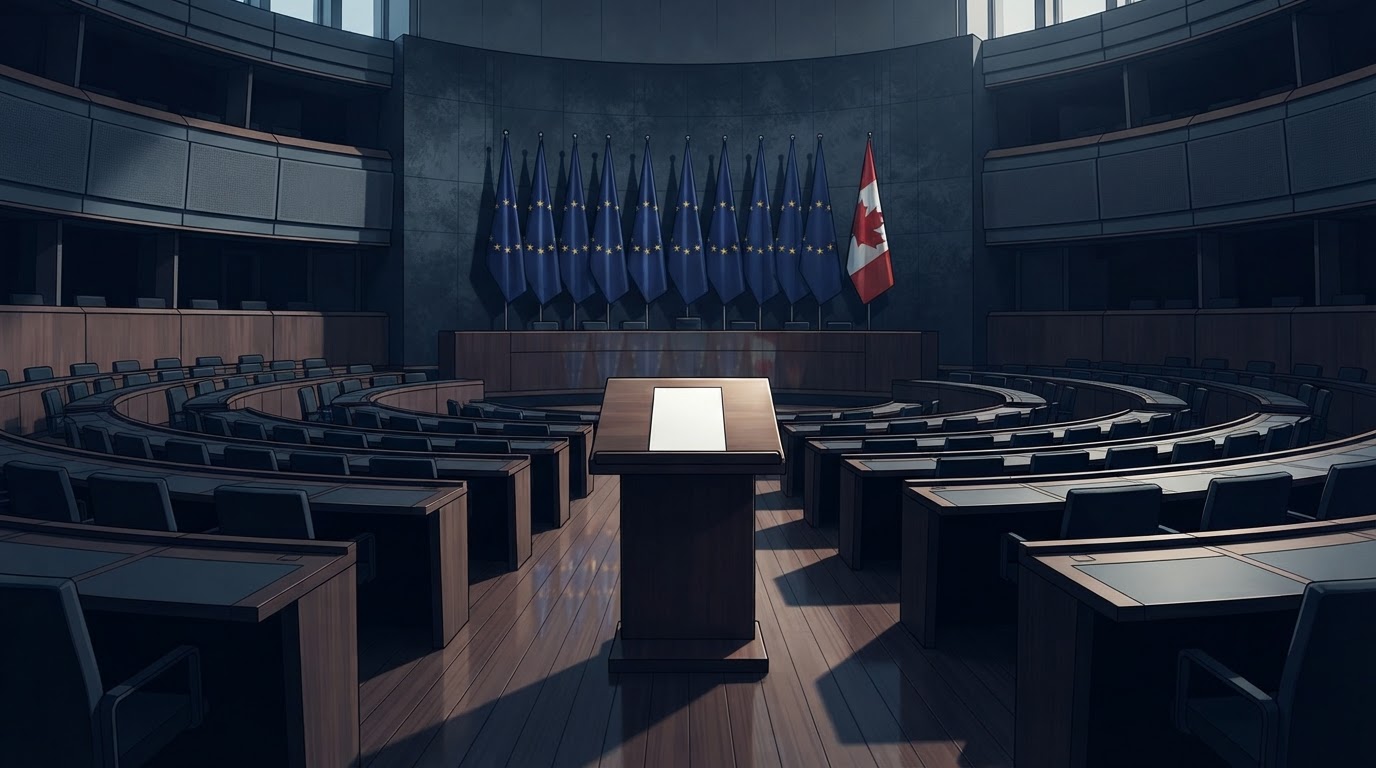
European Commission President Ursula von der Leyen used her annual State of the European Union address in Strasbourg on 16 September 2026 to invite Canada into a relationship with the bloc that has no precedent. Speaking directly to Canadian Prime Minister Mark Carney, who was seated in the chamber, she said she wanted to work with him on opening the door for Canada to become the first associate member of the European Union. The line drew a standing ovation from members of the European Parliament, according to france24.com. Carney addressed the Parliament himself the following day, and cnbc.com reported that he was the first non-European head of government to attend the speech, with an EU-Canada summit scheduled in Montreal next month.
The substance von der Leyen described was expansive. She said the two sides would work on intelligent manufacturing, create a technology alliance, integrate their defence industrial bases and make the Arctic a joint flagship project, and she listed energy, critical minerals, batteries, artificial intelligence, cyber security and economic security as further fields of cooperation, as reported by france24.com. She framed the shift as a move away from a relationship based on trade towards a broader alliance for the future, and said the aim was to bring the relationship with Canada to the highest level possible. She added that the arrangement was directed against no other country and existed for the common strength of both parties.
A category that does not exist in the treaties
The difficulty with the offer is that the thing being offered has no legal content. dw.com noted that associate membership is a position that does not currently exist in the European Union, and that the idea had surfaced days earlier in a Wall Street Journal report that Carney was exploring exactly such a status. The European Union’s treaties provide for accession, for association agreements with third countries, and for the internal market arrangements used by Norway and Switzerland. None of these carries the label von der Leyen used from the podium.
Reporting from Brussels since the speech suggests the confusion is not confined to outside observers. politico.eu reported that the idea was not run past European capitals in advance and had caused considerable confusion, citing four diplomats, and that Ottawa appeared to be distancing itself from the label in the hours before Carney’s own speech. The same report quoted an EU official with knowledge of the talks as saying that associate membership would amount to a new category of partner for enhanced free trade and cooperation on defence, artificial intelligence and high technology science, rather than a rebranding of what already exists. irishtimes.com carried the offer in the same terms the Commission used, as a door being opened by its president.
The questions that have not been put to voters
A new category of partner, created by political announcement rather than by treaty amendment, raises a set of questions that neither Brussels nor Ottawa has yet answered in public. Nobody has published which EU rules Canada would accept, which Canadian regulations would move into alignment with European standards, whether the European Court of Justice would have any role in disputes, or who ratifies the result. Accession to the European Union requires unanimous approval by the twenty-seven member states, and an association of this scope would ordinarily require a negotiated text that national parliaments could read before voting on it. No such text exists, because the concept itself was announced before the content was settled.
Both governments have presented the arrangement as a gain in sovereignty. Integrating defence industrial bases, aligning technology rules and creating a joint prosperity space are, by their nature, exercises in shared decision-making, and shared decision-making means that some decisions are no longer taken in Ottawa alone. Canadian voters were not asked about any of this in the last election, and no measure has been tabled in the House of Commons. The political sequence has run in the reverse of the democratic one, with the offer made in a foreign legislature, the applause recorded, and the terms left to be drafted later by officials.
How the outlets framed it
France 24 and CNBC both treated the offer mainly as a story about Canada and Europe pivoting away from the United States, with the Canadian prime minister welcomed as a partner in difficult times and the legal novelty mentioned in passing. Deutsche Welle placed the absence of any such status in existing European Union structures near the top of its account, which changes the story from a diplomatic milestone into an announcement without a legal basis. Politico Europe went further and reported that European capitals were not consulted, that four diplomats described confusion, and that Ottawa was already stepping back from the label. The difference matters because the warmest framing describes an alliance, while the closest reporting describes an idea that has not been defined, agreed or ratified by anyone.