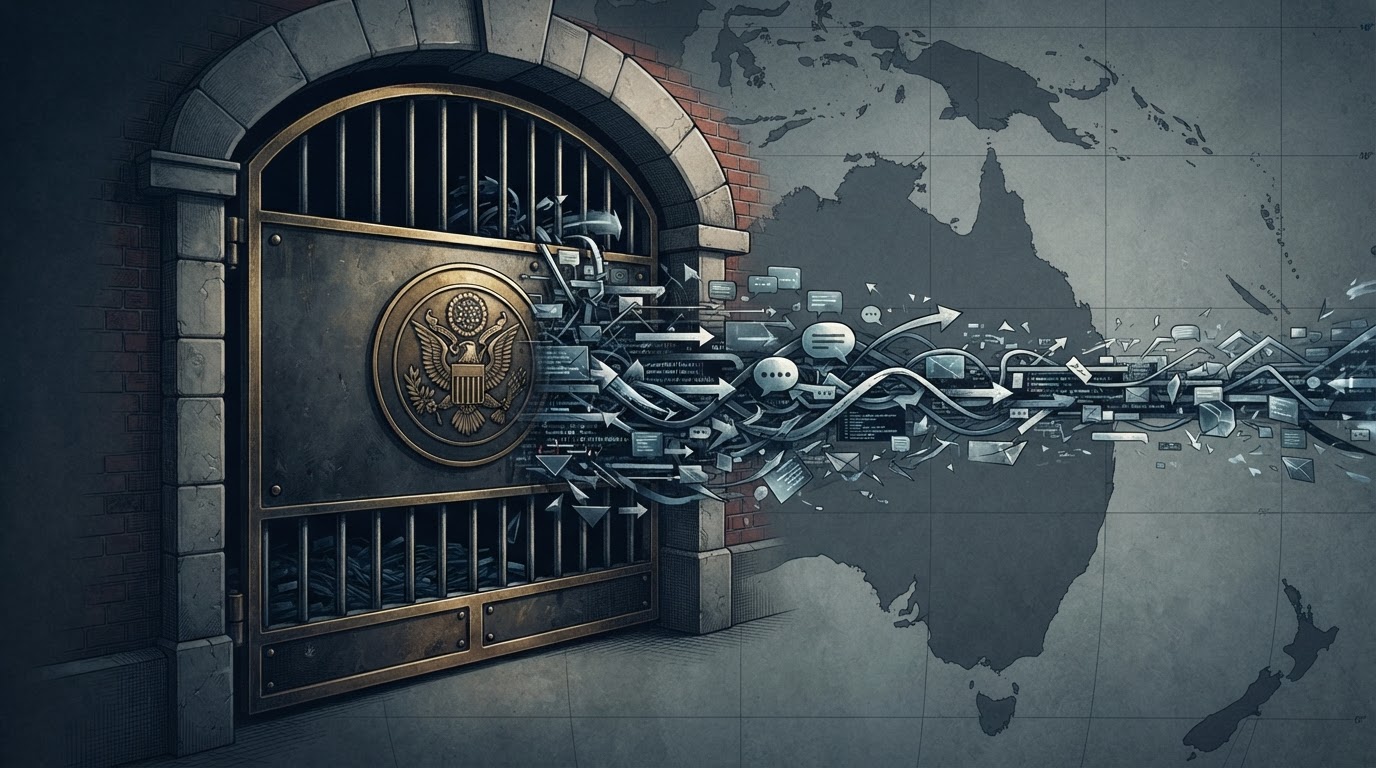
The United States Embassy in Canberra filed a formal submission on 22 September 2026 objecting to Australia’s proposed Online Safety Amendment, known as the Digital Duty of Care Bill 2026, arguing that the draft law could become a tool for viewpoint-based censorship and could shrink the audience reach of independent journalists whose work touches sensitive subjects, according to the embassy’s own published response to the government’s consultation (au.usembassy.gov).
The submission states that keeping the internet free and open is a top priority for the Trump administration, and it warns that forcing platforms to redesign their recommendation systems to avoid liability for what it calls foreseeable harm would likely push companies toward pre-emptive removal or demotion of lawful speech, according to the same document (au.usembassy.gov). It singles out proposed mandates such as forced chronological feeds or opt-in recommendation systems as rigid, one-size-fits-all design rules that could catch protected expression in their net, and it asks the Australian government to spell out exactly how “harm” would be defined and who would be empowered to make that call.
Extraterritorial reach and platform design
Because most of the platforms that would fall under the bill are headquartered in the United States, the embassy submission argues that any Australian requirement to algorithmically suppress content could ripple far beyond Australia’s borders. Platforms typically build features at global scale rather than country by country, so design changes made to satisfy Australian regulators could end up shaping what users everywhere, including Americans, are shown, the submission states (au.usembassy.gov). The document says plainly that Washington opposes foreign measures that result in extraterritorial censorship of protected speech by Americans online.
ABC News described the intervention as an unusual public rebuke of Australian domestic legislation by a foreign government, noting that it arrived through the standard consultation process for the exposure draft rather than through quieter diplomatic channels, according to ABC’s reporting published 22 September 2026 (abc.net.au). The Guardian’s coverage of the same submission reported that the US call for American platforms to be exempted from the regime, framing the dispute as a clash over both free expression and commercial protection for US tech companies, according to that report published 22 September 2026 (theguardian.com).
Australia’s government pushed back the following day. ABC News reported that Prime Minister Anthony Albanese defended the legislation as a matter of Australian sovereignty and public safety, rejecting the suggestion that giving users the choice to opt out of an algorithmic feed amounts to censorship, according to ABC’s report published 23 September 2026 (abc.net.au).
For Canadian readers, the dispute carries an obvious echo. Canada’s own online safety proposals, including identity-verification demands attached to platform access, raise the same underlying question the US submission poses to Australia, namely who decides what counts as harmful content and what happens to lawful but disfavoured speech once platforms are given every incentive to over-moderate rather than risk regulatory penalty. The Australian fight offers a live test of what that trade-off looks like once it moves from a consultation paper into an enforced statute.
How the outlets framed it
ABC News framed the US intervention as extraordinary, stressing that a foreign government rarely inserts itself so directly into another country’s domestic legislative process, which casts the story mainly as a diplomatic anomaly and a test of the Albanese government’s resolve. The embassy’s own submission framed the matter differently, presenting the Australian bill itself as the anomaly, one that risks extraterritorial censorship of protected speech and could demote independent journalism through overbroad algorithmic filtering. The Guardian leaned toward the commercial angle, highlighting the US call for American platforms to be exempted, which shifted the emphasis toward trade protection rather than pure free-speech principle. The contrast shows Australian outlets treating the episode largely as diplomatic friction and sovereignty, while the primary US document treated it as a substantive dispute over speech, platform architecture and the global reach of one country’s rules.