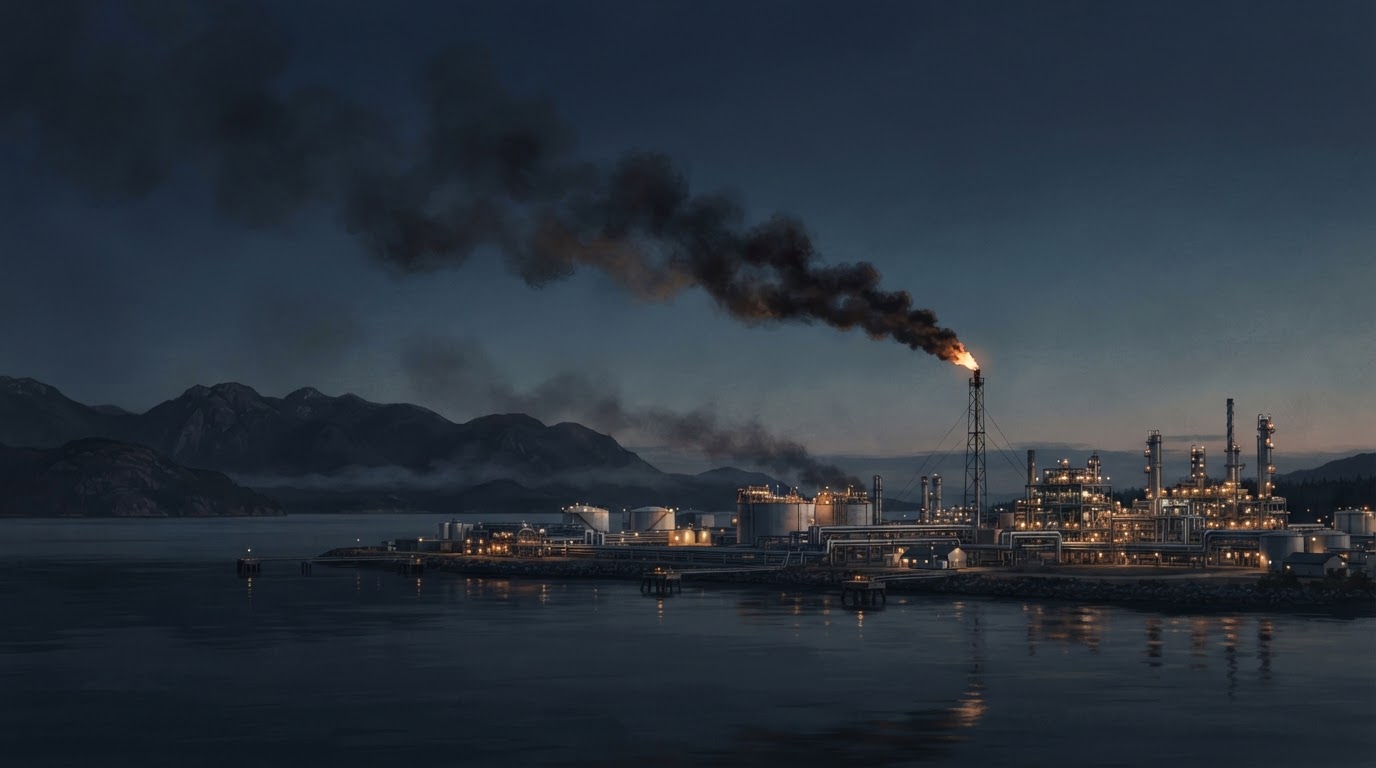
The BC Energy Regulator has published its first compliance report since ordering LNG Canada in April to fix repeated black smoke releases at its Kitimat export terminal, and the numbers show the problem has not gone away. According to the regulator’s own bulletin, LNG Canada reported 20 black smoke events between April 22 and July 31, 2026, plus four more in August, some of which the company itself flagged as non-compliances with its air discharge permit (bc-er.ca, Sept. 21, 2026). Community members told The Narwhal they observed at least one additional event in September, after the reporting period closed (thenarwhal.ca, Sept. 25, 2026).
The regulator’s original order, issued in April, gave LNG Canada until October 15, 2026 to identify the root cause of the black smoke and implement fixes, after the company had already missed an earlier August 15 deadline to submit a root-cause report (thenarwhal.ca). LNG Canada’s deputy chief operating officer, Teresa Waddington, has said the company installed a new flare tip in July that cuts extra gas burned by roughly 60 per cent, but that a full redesign of the flare system will not be finished until 2028, meaning elevated flaring is likely to continue for years (thenarwhal.ca). The company has separately asked the regulator to raise its allowable flaring limit roughly tenfold, from 28 tonnes of gas per day to 300 tonnes, for a three-year period to cover the gap until that redesign is complete (thenarwhal.ca).
Regulator says air quality has not suffered
The BC Energy Regulator maintains that despite the repeated permit exceedances, monitoring stations in Kitimat have not recorded readings above provincial ambient air quality objectives since the plant’s permit was issued in 2024, and that a third-party air dispersion assessment found the added flaring has only a small to negligible effect on local air quality (bc-er.ca). That reassurance sits awkwardly beside the regulator’s own enforcement record: the order issued in April remains in effect, LNG Canada must now file monthly effectiveness reports through March 2027, and the regulator has not said what happens if the company still cannot meet the October 15 deadline for permanent fixes.
The compliance report lands just as LNG Canada’s owners, led by Shell, weigh a final investment decision on a Phase 2 expansion that would double production capacity at the Kitimat site, with a decision reportedly possible as early as October, according to Narwhal reporting that cites earlier wire coverage of the timeline (thenarwhal.ca). Both the federal and provincial governments have publicly signalled strong support for the expansion, a stance CBC News has also reported alongside details of the regulator’s April enforcement order (cbc.ca).
The timing raises an obvious question that none of the public statements from Victoria, Ottawa or the regulator directly address: whether a project still failing to meet emissions conditions set less than two years ago should be treated as a settled success story worth doubling in size before its own compliance file is closed.
How the outlets framed it
The Narwhal’s reporting treats the repeated black smoke events as evidence of a pattern the BC Energy Regulator and provincial government appear willing to tolerate because LNG Canada is the province’s flagship energy project, emphasising the gap between the plant’s original emissions predictions and its actual record. CBC News reported the same April enforcement order more as a procedural regulatory story, noting the deadlines and requirements without extending the analysis into the politics of the pending expansion decision. The BC Energy Regulator’s own statements frame the situation as evidence that its oversight is working, pointing to air quality data as proof the flaring has caused no measurable harm. The contrast shows a widening gap between an independent outlet’s scrutiny of enforcement follow-through and the calmer, technical tone of both the regulator’s self-assessment and mainstream coverage of the compliance order.