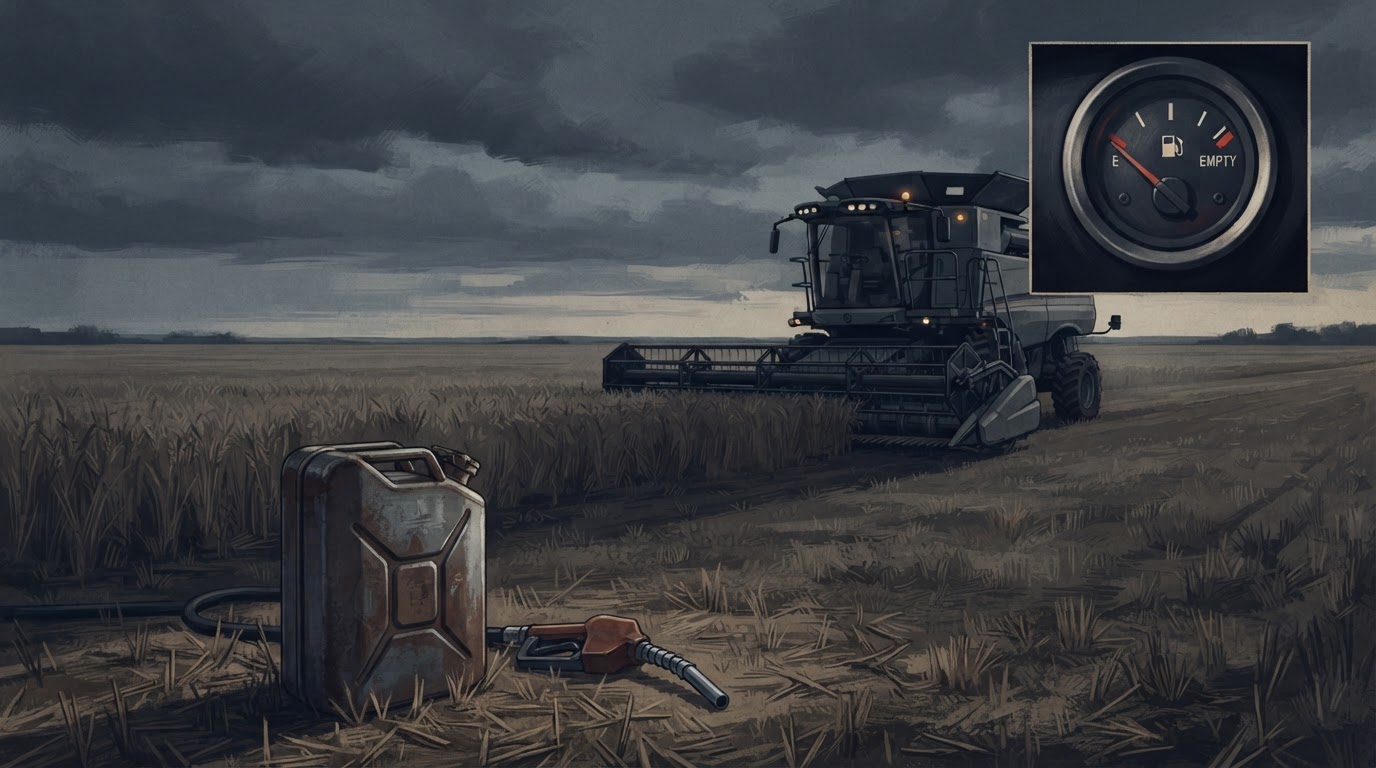
Farmers across the Prairies and Ontario are absorbing some of the steepest fuel bills on record just as this year’s harvest, already delayed by wet weather, demands the heaviest use of diesel-powered equipment. Columnist Kevin Hursh reported in SaskAgToday that bulk dyed diesel for farm use is now priced above $2.00 a litre, roughly double where it stood a year earlier, and noted that a large combine burning 80 litres an hour can push a single harvest’s fuel bill toward $32,000 before counting grain trucks, tractors and crop-drying costs.
Fertilizer costs are compounding the problem. Hursh’s reporting also tracked urea moving from under $800 a tonne over the summer to the $900 range by autumn, with phosphate holding near $1,400 a tonne and showing no sign of the seasonal price reset that sometimes gives producers a window to buy ahead.
Industry group points farmers toward AgriStability
The Agricultural Producers Association of Saskatchewan has responded by urging members to look again at AgriStability before an extended October 1 enrolment deadline, according to a release summarized by Syngenta Canada. The group estimated that the near-doubling of diesel costs is adding roughly $20 an acre to production expenses, which works out to about $72,000 for a 3,600-acre grain operation. APAS President Bill Prybylski was quoted saying that between higher fuel and fertilizer costs, delayed seeding, wet harvest conditions and trade uncertainty, 2026 has been a difficult year for producers, and he argued that AgriStability has changed enough since its earlier, less-trusted years that producers should reassess it rather than dismiss it on reputation. The program paid out about $402 million to Saskatchewan producers in 2025, the release said.
The pressure is not confined to Saskatchewan. CBC News reported from Ontario that Natural Resources Canada figures put the national average diesel price at $2.75 a litre in mid-September, well above the previous record of $2.25 set in 2022 during the disruption that followed Russia’s invasion of Ukraine. Bruce County farmer Gerard Grubb told CBC that filling his combine, which he does daily, used to cost $1,800 and now costs $2,800, adding hundreds of thousands of dollars to his annual diesel spending. Fellow Ontario farmers Jesse Kenwell and Kyle Schuknecht told CBC they feel government has been slow to respond, even as Premier Doug Ford pointed to a permanent five-cent-a-litre provincial fuel tax cut and pressed Ottawa to extend its own fuel excise tax reduction past January.
A similar story is playing out on Prince Edward Island, where CBC News reported that Kinkora farmer Nathan Lawless has seen his diesel costs roughly double partway through this year’s wheat and barley harvest, from about $7,000 last year to more than $14,000 so far this season, with two 950-litre combine tanks needing refills every couple of days.
Grocery prices could follow with a delay
The knock-on effect may reach supermarket shelves. Dalhousie University food economist Sylvain Charlebois told 650 CKOM that his lab’s models point to roughly a 0.6 percentage point increase in retail food inflation within four to eight weeks, driven largely by trucking surcharges that are already being applied by distributors and food-service suppliers. Charlebois said diesel is one of the few input costs that moves through to grocery prices quickly, with a correlation of 0.89 between diesel prices and retail food costs in his lab’s data, even though the full impact takes weeks to appear on receipts because transport contracts are locked in ahead of time.
How the outlets framed it
SaskAgToday’s column by Kevin Hursh treats the diesel and fertilizer spike mainly as an accounting problem, laying out per-acre and per-hour cost math without dwelling on politics. The APAS release, carried by Syngenta Canada, frames the same numbers as a case for using an existing federal-provincial program, presenting AgriStability as underused rather than the cost spike itself as a policy failure. CBC’s coverage from Ontario and PEI instead centres individual farmers describing feeling abandoned by government, with direct quotes pressing Ottawa and Queen’s Park for relief. The contrast shows a gap between institutional messaging, which points producers toward existing supports, and farmer testimony suggesting those supports have not kept pace with costs that have doubled in a single season.